
How to Choose a Portable Projector for Movie Nights, Home Entertainment, and Outdoor Use?
If you are looking for the best portable projector for movies and outdoor use in 2026, the best choice is not necessarily the brightest or most expensive model. The right projector should match your room, screen size, ambient light, portability needs, and budget.
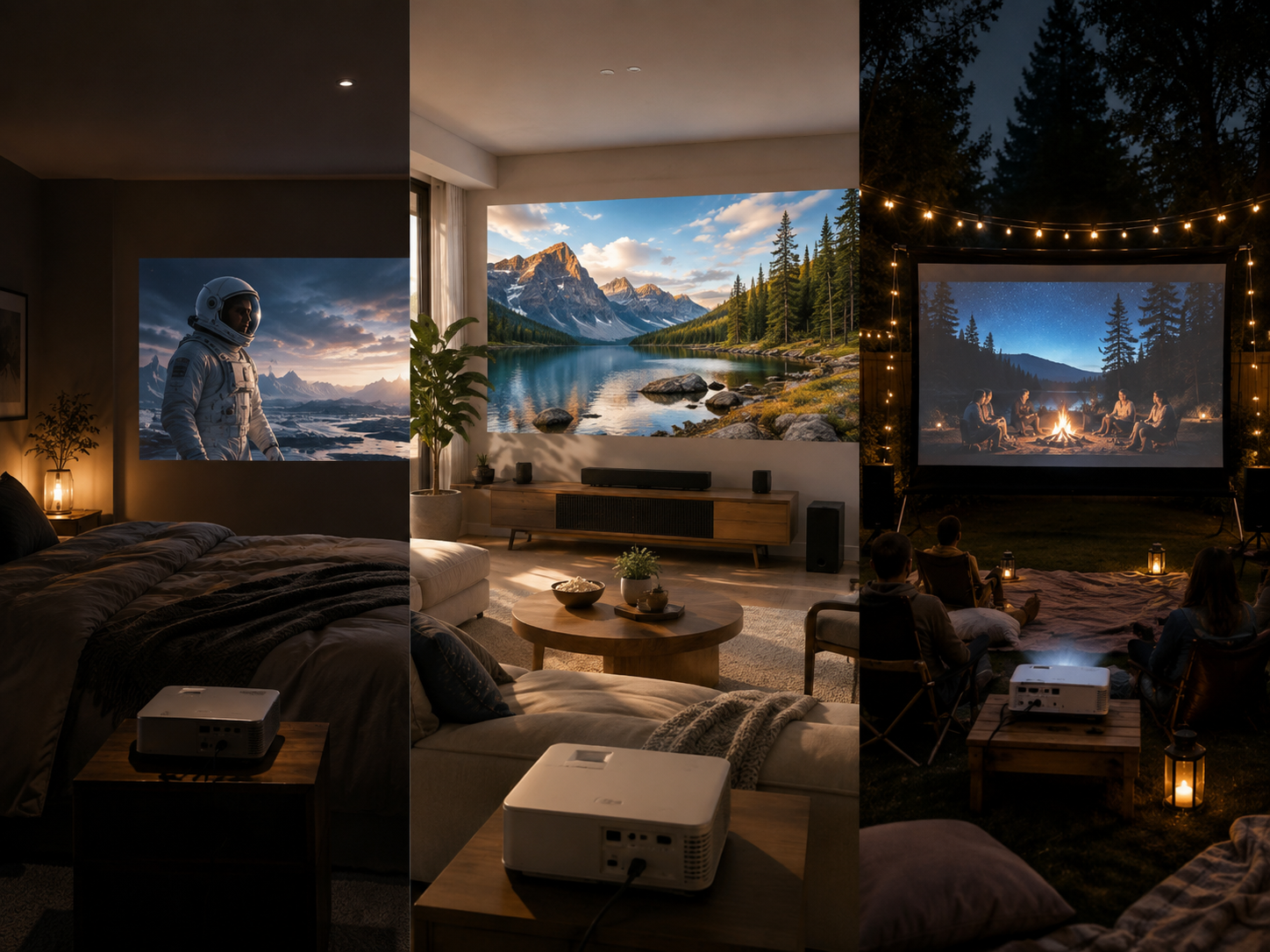
For bedroom movies and apartment entertainment, a compact 1080p smart projector offers an excellent balance of image quality, large-screen size, and affordability. For outdoor movie nights, brightness, portability, autofocus, audio, and power options become more important.
If you mainly watch during the day in a bright room, a TV may still provide a more consistent viewing experience.
Best Portable Projector at a Glance
|
Use Case |
What to Prioritize |
Recommended Type |
|
Bedroom movie night |
Compact size, 1080p, smart features |
Mini / Smart Projector |
|
Apartment |
Portability, brightness, easy setup |
Portable Projector |
|
Outdoor movies |
Brightness, portability, autofocus |
Outdoor Projector |
|
Large-screen movies |
Brightness, resolution, throw distance |
High-Brightness Projector |
|
Dedicated home theater |
Image quality, contrast, audio |
Home Theater Projector |
|
Bright daytime viewing |
Brightness, contrast |
TV / High-Brightness Projector |
What Makes a Good Portable Projector?
A good portable projector needs to balance image quality and convenience.
For indoor movie nights, the most important factors are resolution, contrast, smart features, sound, and noise. For outdoor projection, brightness, portability, setup speed, and power become more important.
When comparing a portable projector, mini projector, or budget projector, consider these factors:
· Brightness
· Native resolution
· Autofocus and keystone correction
· Smart operating system
· Wi-Fi and Bluetooth connectivity
· Portability
· Throw distance
· Screen size
· Audio
· Power requirements
The key is to understand what each specification means in real-world use.
1. Brightness: The Key Factor for Outdoor Projection
Brightness determines how clearly you can see the projected image when ambient light is present.
A projector that looks excellent in a dark bedroom may look washed out outdoors before sunset.
For example:
· Dark bedroom: moderate brightness can be sufficient.
· Living room with lights: higher brightness is preferable.
· Backyard after sunset: higher brightness helps maintain image impact.
· Outdoor viewing before sunset: brightness becomes especially important.
Screen size matters too. As the projected image gets larger, the available light is spread over a larger area.
Simple rule:
The larger the screen and the brighter the environment, the more brightness you need.
This is why a higher-performance portable projector can be more versatile than an ultra-small mini projector when both indoor and outdoor use are important.
2. Is 1080p Enough for a Portable Movie Projector?
For most buyers, native 1080p remains a practical sweet spot in 2026.
A native 1080p projector can deliver detailed Full HD images while maintaining a reasonable balance between price, power consumption, and performance.
4K projectors can provide greater detail, particularly on very large screens, but buyers should distinguish between native resolution and supported input resolution.
A projector that supports 4K input does not necessarily have a native 4K display.
For budget-conscious movie lovers, a well-designed native 1080p projector can offer a better overall experience than a low-cost projector that prioritizes a higher specification while compromising brightness, optics, or system performance.
3. Autofocus and Keystone Make Portable Projection Easier
Portability means you will probably move your projector frequently.
You may use it on a bedroom nightstand today, a living-room table tomorrow, and a tripod outdoors at the weekend.
That's why autofocus and automatic keystone correction are particularly valuable features for portable projectors.
Autofocus quickly restores image sharpness after the projector is moved, while keystone correction helps correct the image when the projector is not perfectly aligned with the screen.
For the best image quality, physical positioning should still come first. Digital correction is best treated as a convenience feature rather than something to rely on heavily.
4. Smart Features Matter for Movie Nights
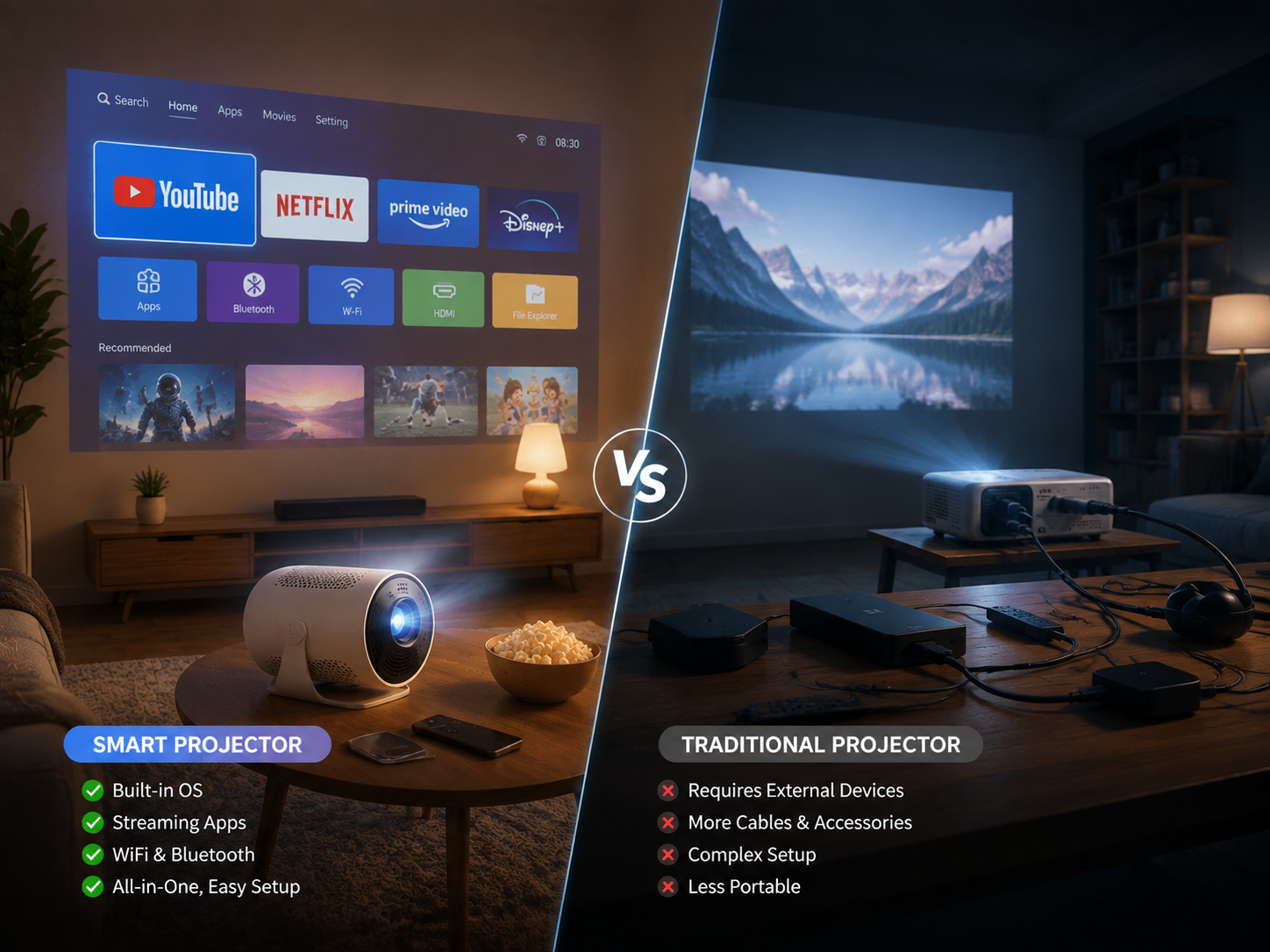
A modern smart projector can combine the functions of a display, streaming device, and wireless entertainment hub.
Important features include:
· Wi-Fi
· Bluetooth
· HDMI
· Screen mirroring
· USB playback
· External speaker support
· Streaming compatibility
For streaming users, always check whether the specific projector supports the services you use. Smart features vary between models and operating systems.
A good smart projector should make it easy to move from:
Turn on → Connect → Select content → Start watching.
That simplicity is especially valuable for portable and outdoor setups.
5. How Portable Should a Projector Be?
Smaller does not always mean better.
An ultra-compact mini projector may be easier to carry, but it can sacrifice brightness, cooling, audio, or connectivity.
Choose a Mini Projector If:
· You travel frequently.
· You mainly watch in dark rooms.
· You prioritize size and weight.
· You only need occasional large-screen entertainment.
Choose a Higher-Performance Portable Projector If:
· You use it indoors and outdoors.
· You regularly want 80–120-inch images.
· You need higher brightness.
· You want better built-in audio.
· You want a more complete smart projector experience.
For many users, the best portable projector is therefore not the smallest model but the best balance between portability and performance.
6. What Screen Size Is Best?
For most portable movie setups, 80–120 inches offers a good balance between immersion and practicality.
|
Screen Size |
Best For |
|
60–80" |
Bedroom / Small Room |
|
80–100" |
Apartment / Bedroom |
|
100–120" |
Living Room / Outdoor Movie Night |
|
120"+ |
Large Outdoor Setup / Home Theater |
However, screen size should always be matched to projector brightness and throw distance.
A 120-inch image is not automatically better than a 100-inch image. If the projector does not provide enough light, reducing the screen size can produce a brighter and more satisfying picture.
7. Projector Screen or Wall?
A clean white wall can work for casual viewing, but a dedicated projector screen provides a more consistent surface.
A wall can introduce:
· Texture
· Unevenness
· Color shifts
· Reflections
For outdoor movie nights, a portable screen is especially useful because it provides a flat, predictable projection surface and can be quickly assembled and stored.
For users who frequently move their projector between locations, a portable screen can significantly improve the overall setup.
8. Best Portable Projector for Different Scenarios
Bedroom Movie Nights
Prioritize:Compact size + native 1080p + autofocus + smart features
A mini or compact smart projector is usually the most practical option.
Apartment Entertainment
Prioritize:Portability + brightness + flexible placement + easy streaming
A portable smart projector can turn a blank wall into a large movie screen without permanently occupying the room.
Outdoor Movie Nights
Prioritize:Brightness + portability + autofocus + screen compatibility + reliable power
A 100–120-inch portable screen can provide a more consistent outdoor viewing experience.
Home Theater
Prioritize:Image quality + contrast + resolution + screen + audio
If the projector will stay permanently in one room, portability becomes less important than overall picture quality.
9. Portable Projector vs TV: Which Is Better?
The answer depends on your priorities.
|
Priority |
Better Choice |
|
80–120" large screen |
Projector |
|
Movie-night atmosphere |
Projector |
|
Outdoor viewing |
Projector |
|
Flexible placement |
Projector |
|
Bright daytime viewing |
TV |
|
Strong HDR / black levels |
TV |
|
Simple setup |
TV |
|
Everyday TV watching |
TV |
A TV generally offers stronger brightness and contrast in bright environments.
A projector, however, can provide a much larger image for the money and create a more cinematic viewing experience.
For users who mainly watch movies at night, the projector advantage becomes particularly noticeable.
10. Where Magcubic Fits
Magcubic focuses on affordable premium projection, helping users create large-screen entertainment without the cost and fixed installation of a very large TV.
Different Magcubic models target different combinations of portability, brightness, resolution, and smart features.
For example, the Magcubic HY450 Max is designed for users looking for a higher-performance smart projector, combining 1100 ANSI brightness, native 1080p resolution, Android 14, Wi-Fi 6, and 8K input support.
This makes it a strong option for users who want a versatile projector for larger indoor movie nights while retaining the flexibility to move the setup when needed.
The important point is that the best Magcubic projector depends on your room, screen size, brightness requirements, and usage scenario—not simply the highest specification.
How to Choose the Best Portable Projector in 2026
Use this simple decision framework:
1. Where will you use it?
Bedroom, apartment, living room, dorm, backyard, or home theater?
2. How large do you want the image?
For most portable setups, 80–120 inches is a practical target.
3. How much ambient light is present?
More ambient light means you should prioritize higher brightness.
4. How often will you move it?
Frequent movement makes autofocus, keystone correction, compact design, and setup speed more important.
5. What is your total setup budget?
Consider the cost of the projector, screen, speakers, streaming device, tripod, and power accessories—not just the projector itself.
FAQ
What is the best portable projector for movies in 2026?
The best portable projector depends on your environment. For indoor movies, prioritize native 1080p, smart features, autofocus, image quality, and low noise. For outdoor use, brightness, portability, screen compatibility, and power become more important.
Is 1080p enough for a portable projector?
Yes. Native 1080p provides an excellent balance of image quality and value for most movie-night setups.
How bright should an outdoor projector be?
The required brightness depends on ambient light and screen size. A completely dark backyard requires less brightness than an outdoor setup used around sunset.
Can I use a projector on a wall?
Yes. A clean, flat, neutral-colored wall can work for casual viewing. A projector screen provides a more consistent image.
Is a projector better than a TV for movies?
A projector is generally better for users who prioritize large-screen immersion and mainly watch movies in darker environments. A TV is usually better for bright rooms and simple everyday viewing.
What screen size is best for outdoor movies?
For many backyard setups, 100–120 inches provides a good balance of immersion, viewing distance, and portability.
Final Summary
The best portable projector for movies and outdoor use in 2026 is not necessarily the smallest, brightest, or most expensive model.
It is the projector that best matches your:Room + Ambient Light + Screen Size + Portability + Content + Budget.
For bedroom movies, choose compact smart features and 1080p resolution. For outdoor movie nights, prioritize brightness, portability, fast setup, and a suitable screen. For home theater, put image quality and screen performance ahead of portability.
For buyers looking for an affordable premium projector, Magcubic provides a range of options designed around these different viewing scenarios.
The goal isn't to buy the projector with the biggest specification sheet. The goal is to choose the projector that creates the best cinematic experience for your space.